
Analyse ABC dans la réeducation comportementale

ABC du comportement animal

Connaissez-vous l’analyse fonctionnelle du comportement, adaptée par Susan Friedman aux animaux, pour modifier un comportement animal non désiré.

Brian Iwata et al. (1982) avaient démontré que l’on peut identifier expérimentalement la fonction d’un comportement en manipulant les antécédents et les conséquences. Les fonctions typiques clairement identifiées sont d’obtenir quelque chose, d’éviter quelque chose et d’avoir une stimulation sensorielle.

Le comportement fait partie d’une multitude d’interactions entre la génétique d’un individu, ses apprentissages et expériences , et le contexte environnemental dans lequel ce comportement prend effet.

Afin d’augmenter notre capacité à comprendre et influencer le comportement de nos animaux, nous avons besoin d’une approche raisonnée, qui nous procurera une structure de travail organisée et simplifiera la complexité apparente, qui sinon menace d’obscurcir notre vue d’ensemble.

L’une des approches, permettant de comprendre un comportement spécifique, est connue sous le terme d’analyse ABC. Ces lettres représentent les trois éléments d’une équation comportementale incluant les antécédents, le behavior (comportement en anglais) et les conséquences. Au moyen de cette stratégie, nous cherchons par une observation fine et prudente, sans interprétation, à identifier ce qui se passe et les conditions dans lesquelles les choses se déroulent avant l’apparition du comportement cible, et cherchons aussi à identifier les conséquences de ce comportement.

Il est essentiel ainsi de rechercher la fonction du comportement indésirable.

Les 3 piliers
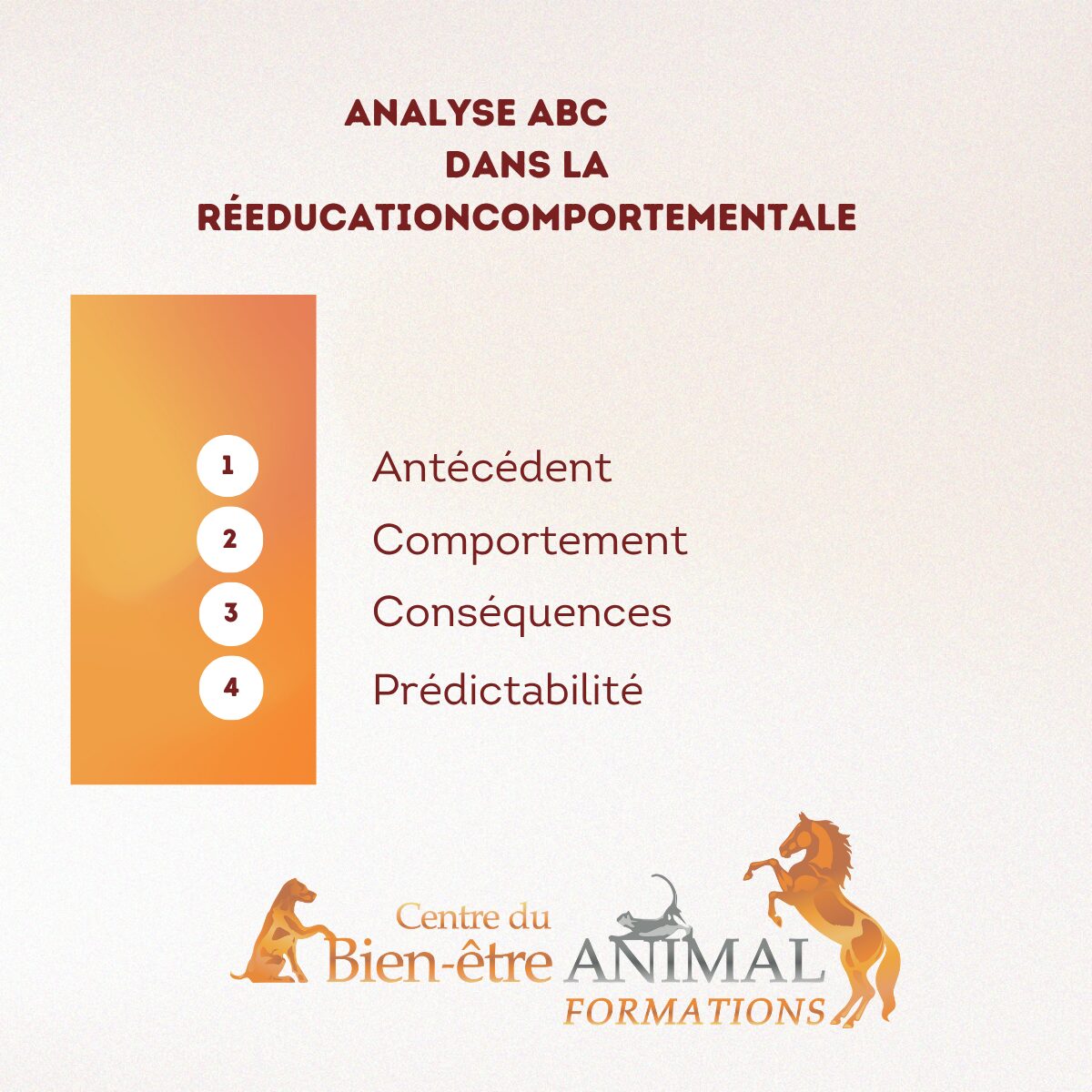
A – Antécédents
Contexte, signaux, émotions, environnement, déclencheurs.

B – Comportement
Action observable et mesurable (ce que l’animal fait réellement) avec description de toute la séquence : début, action et phase d’arrêt.

C – Conséquences
Ce qui suit le comportement et influence sa répétition


Il y a 6 étapes pour analyse l’ABC:

(1) décrire le comportement cible en termes clairs et précis;

(2) décrire les faits et conditions précédant immédiatement l’occurrence de ce comportement;

(3) décrire les conséquences immédiates de ce comportement; (4) séquencer les antécédents, le comportement et ses conséquences;

(5) imaginez et créer de nouveaux antécédents et/ou conséquences afin d’enseigner de nouveaux comportements ou de transformer l’apparition de l’un d’entre eux;

(6) évaluer le résultat.


Au Centre du Bien-être Animal nous enseignons, au futur éducateur canin et comportementaliste équin, l’analyse ABC comme outil central de compréhension et de décision pour identifier les éléments qui contrôlent et motivent le comportement et construire des interventions précises, mesurables et durables pour chaque chien ou cheval en rééducation comportementale.

C’est une approche professionnelle rigoureuse et éthique basée sur la science nécessitant une observation fine, une compréhension de la fonction du comportement , de découvrir les antécédents immédiats et anciens, et d’analyser les conséquences.

Elle permet d’amoindrir les interprétations, avec plus d’observation et de lecture comportementale, avec des résultats concrets, au service de la performance, du bien-être animalet d’une relation de confiance humain-animal.

Elle permet d’identifier précisément la fonction du comportement.

Son objectif est de comprendre et non corriger, d’ajuster l’environnement et les interactions, et de développer des comportements adaptés par renforcement positif avec des nouvelles compétences apprises en amont, afin de remplacer les comportements non désirés.

Nous proposerons en priorité des nouveaux comportements, ayant la même fonction que ceux non souhaitables.

Exemples

Antécédent 1 : la porte d’entrée s’ouvre et une personne entre

Comportement 1 : Médor aboit

Conséquence 1/Antécédent 2 : la personne dit « non »

Comportement 2 : Médor « pince »

Conséquence 2 : je lui donne un jouet pour détourner son attention

Prédictabilité : les comportements 1 et 2 vont augmenter en fréquence.

Fonctions probables :

  1. Intrinsèque (excitabilité)
  2. Accès au jouet


Merci beaucoup de votre lecture et de partager.

Pat Rérolle

Brian Iwata et al. (1982) : Toward a Functional Analysis of Self-Injury


"Nous utilisons des cookies pour personnaliser le contenu et les annonces, fournir des fonctionnalités de médias sociaux et analyser notre trafic. Nous partageons également des informations sur votre utilisation de notre site avec nos partenaires de médias sociaux, de publicité et d'analyse."
Cookies settings
Accept
Decline
Privacy & Cookie policy
Privacy & Cookies policy
Cookie name Active

Privacy Policy

What information do we collect?

We collect information from you when you register on our site or place an order. When ordering or registering on our site, as appropriate, you may be asked to enter your: name, e-mail address or mailing address.

What do we use your information for?

Any of the information we collect from you may be used in one of the following ways: To personalize your experience (your information helps us to better respond to your individual needs) To improve our website (we continually strive to improve our website offerings based on the information and feedback we receive from you) To improve customer service (your information helps us to more effectively respond to your customer service requests and support needs) To process transactions Your information, whether public or private, will not be sold, exchanged, transferred, or given to any other company for any reason whatsoever, without your consent, other than for the express purpose of delivering the purchased product or service requested. To administer a contest, promotion, survey or other site feature To send periodic emails The email address you provide for order processing, will only be used to send you information and updates pertaining to your order.

How do we protect your information?

We implement a variety of security measures to maintain the safety of your personal information when you place an order or enter, submit, or access your personal information. We offer the use of a secure server. All supplied sensitive/credit information is transmitted via Secure Socket Layer (SSL) technology and then encrypted into our Payment gateway providers database only to be accessible by those authorized with special access rights to such systems, and are required to?keep the information confidential. After a transaction, your private information (credit cards, social security numbers, financials, etc.) will not be kept on file for more than 60 days.

Do we use cookies?

Yes (Cookies are small files that a site or its service provider transfers to your computers hard drive through your Web browser (if you allow) that enables the sites or service providers systems to recognize your browser and capture and remember certain information We use cookies to help us remember and process the items in your shopping cart, understand and save your preferences for future visits, keep track of advertisements and compile aggregate data about site traffic and site interaction so that we can offer better site experiences and tools in the future. We may contract with third-party service providers to assist us in better understanding our site visitors. These service providers are not permitted to use the information collected on our behalf except to help us conduct and improve our business. If you prefer, you can choose to have your computer warn you each time a cookie is being sent, or you can choose to turn off all cookies via your browser settings. Like most websites, if you turn your cookies off, some of our services may not function properly. However, you can still place orders by contacting customer service. Google Analytics We use Google Analytics on our sites for anonymous reporting of site usage and for advertising on the site. If you would like to opt-out of Google Analytics monitoring your behaviour on our sites please use this link (https://tools.google.com/dlpage/gaoptout/)

Do we disclose any information to outside parties?

We do not sell, trade, or otherwise transfer to outside parties your personally identifiable information. This does not include trusted third parties who assist us in operating our website, conducting our business, or servicing you, so long as those parties agree to keep this information confidential. We may also release your information when we believe release is appropriate to comply with the law, enforce our site policies, or protect ours or others rights, property, or safety. However, non-personally identifiable visitor information may be provided to other parties for marketing, advertising, or other uses.

Registration

The minimum information we need to register you is your name, email address and a password. We will ask you more questions for different services, including sales promotions. Unless we say otherwise, you have to answer all the registration questions. We may also ask some other, voluntary questions during registration for certain services (for example, professional networks) so we can gain a clearer understanding of who you are. This also allows us to personalise services for you. To assist us in our marketing, in addition to the data that you provide to us if you register, we may also obtain data from trusted third parties to help us understand what you might be interested in. This ‘profiling’ information is produced from a variety of sources, including publicly available data (such as the electoral roll) or from sources such as surveys and polls where you have given your permission for your data to be shared. You can choose not to have such data shared with the Guardian from these sources by logging into your account and changing the settings in the privacy section. After you have registered, and with your permission, we may send you emails we think may interest you. Newsletters may be personalised based on what you have been reading on theguardian.com. At any time you can decide not to receive these emails and will be able to ‘unsubscribe’. Logging in using social networking credentials If you log-in to our sites using a Facebook log-in, you are granting permission to Facebook to share your user details with us. This will include your name, email address, date of birth and location which will then be used to form a Guardian identity. You can also use your picture from Facebook as part of your profile. This will also allow us and Facebook to share your, networks, user ID and any other information you choose to share according to your Facebook account settings. If you remove the Guardian app from your Facebook settings, we will no longer have access to this information. If you log-in to our sites using a Google log-in, you grant permission to Google to share your user details with us. This will include your name, email address, date of birth, sex and location which we will then use to form a Guardian identity. You may use your picture from Google as part of your profile. This also allows us to share your networks, user ID and any other information you choose to share according to your Google account settings. If you remove the Guardian from your Google settings, we will no longer have access to this information. If you log-in to our sites using a twitter log-in, we receive your avatar (the small picture that appears next to your tweets) and twitter username.

Children’s Online Privacy Protection Act Compliance

We are in compliance with the requirements of COPPA (Childrens Online Privacy Protection Act), we do not collect any information from anyone under 13 years of age. Our website, products and services are all directed to people who are at least 13 years old or older.

Updating your personal information

We offer a ‘My details’ page (also known as Dashboard), where you can update your personal information at any time, and change your marketing preferences. You can get to this page from most pages on the site – simply click on the ‘My details’ link at the top of the screen when you are signed in.

Online Privacy Policy Only

This online privacy policy applies only to information collected through our website and not to information collected offline.

Your Consent

By using our site, you consent to our privacy policy.

Changes to our Privacy Policy

If we decide to change our privacy policy, we will post those changes on this page.
Save settings
Cookies settings