
Réactivité canine : les méthodes scientifiquement validées pour les éducateurs canins comportementalistes

Comprendre la réactivité canine : définition, causes et prise en charge scientifique

Réactivité canine : les règles clés validées par la science pour les éducateurs canins comportementalistes

La réactivité canine est aujourd’hui l’un des motifs de consultation les plus fréquents chez les éducateurs canins comportementalistes. Pourtant, elle reste encore largement mal comprise et souvent confondue avec un problème d’obéissance ou d’agressivité.

Les données scientifiques actuelles montrent pourtant que la réactivité est avant tout un phénomène émotionnel, nécessitant une approche comportementale rigoureuse et non coercitive.

Dans cet article, nous allons détailler les principes fondamentaux validés par la recherche scientifique pour comprendre et accompagner efficacement un chien réactif

Qu’est-ce que la réactivité canine ?

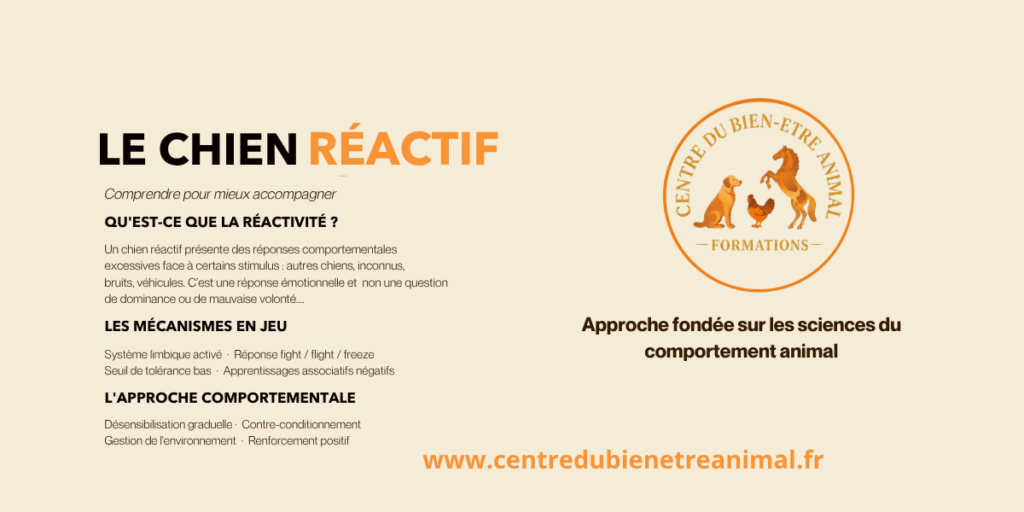
La réactivité canine correspond à une réponse émotionnelle intense face à un stimulus particulier, tel que :

  • un autre chien ;
  • un humain ;
  • un véhicule ;
  • un animal ;
  • un environnement spécifique.

Cette réaction est généralement liée à des émotions telles que :

  • la peur ;
  • la frustration ;
  • l’anxiété ;
  • le stress chronique ;
  • l’incertitude.

Contrairement à certaines croyances encore répandues, la réactivité canine n’est pas un problème d’obéissance.

Proposer uniquement des exercices d’éducation classiques comme :

  • « assis » ;
  • « au pied » ;
  • « pas bouger » ;

s’avère généralement inefficace lorsque le chien est en état de surcharge émotionnelle.

Définition experte de la réactivité canine

La réactivité canine peut être définie comme :

Un comportement émotionnel visant à gérer, augmenter ou contrôler la distance avec un stimulus perçu comme difficile, menaçant ou incontrôlable.

Cette définition place l’émotion au centre de l’analyse comportementale, conformément aux approches modernes de l’éthologie appliquée.

Un chien réactif est-il forcément agressif ?

Non.

La réactivité ne doit pas être confondue avec l’agressivité.

Elle peut se manifester sous différentes formes :

  • aboiements ;
  • vocalisations ;
  • tensions sur la laisse ;
  • fixation visuelle ;
  • comportements d’évitement ;
  • comportements de menace ;
  • tentatives de fuite ;
  • charges défensives.

Ces comportements constituent souvent des stratégies d’adaptation émotionnelle et non une volonté d’agresser.

La règle fondamentale : travailler sous le seuil émotionnel

Le principe majeur validé par les sciences comportementales est le suivant :

Le chien doit rester sous son seuil émotionnel.

Le seuil émotionnel correspond au niveau d’activation à partir duquel le chien n’est plus capable :

  • d’apprendre ;
  • de mémoriser ;
  • d’analyser son environnement ;
  • de gérer ses émotions.

Comment savoir si le chien dépasse son seuil émotionnel ?

Si le chien :

  • aboie ;
  • charge ;
  • fixe intensément ;
  • refuse les récompenses ;
  • ne répond plus à son environnement ;

alors il est probablement au-dessus de son seuil émotionnel.

Dans cet état, les réflexes de défense apparaissent et les capacités d’apprentissage diminuent et deviennent nulles.

Faut-il corriger un chien réactif ?

La réponse scientifique actuelle est claire : surtout pas.

Les méthodes coercitives peuvent entraîner des effets délétères clairement démontrés avec :

  • une augmentation du stress ;
  • une aggravation des émotions négatives ;
  • une détérioration de la relation humain-chien ;
  • une augmentation du risque de comportements agressifs.

Avant toute rééducation comportementale toujours vérifier :

L’état de santé du chien

Certaines pathologies ou douleurs chroniques peuvent favoriser ou amplifier la réactivité.

Le respect des besoins éthologiques

Le chien bénéficie-t-il :

  • d’activités adaptées ?
  • d’explorations suffisantes ?
  • d’interactions sociales appropriées ?
  • de repos de qualité ?

La qualité de la relation humain-animal

La sécurité émotionnelle et la prévisibilité des interactions jouent un rôle majeur dans l’évolution comportementale.

Quelles méthodes sont scientifiquement reconnues pour traiter la réactivité canine ?

La première étape consiste à réaliser une analyse fonctionnelle précise :

  • identifier les déclencheurs ;
  • décrire les comportements observés sans interprétation ;
  • analyser les conséquences ;
  • identifier les facteurs aggravants.

Les recherches scientifiques mettent ensuite en évidence deux approches majeures.

1. La désensibilisation graduelle

La désensibilisation consiste à exposer progressivement le chien au déclencheur :

  • à une intensité très faible ;
  • à une distance compatible avec ses capacités émotionnelles ;
  • sans provoquer de réaction excessive.

L’objectif est de maintenir constamment le chien sous son seuil émotionnel afin de favoriser les apprentissages.

2. Le contre-conditionnement

Le contre-conditionnement consiste à associer progressivement le stimulus déclencheur à des conséquences positives :

  • alimentation ;
  • jeu ;
  • activités appréciées ;
  • interactions agréables.

L’objectif n’est pas simplement de modifier le comportement observable, mais surtout de transformer l’émotion ressentie par le chien.

Le consensus scientifique actuel

Les travaux scientifiques en médecine comportementale vétérinaire et en comportement animal convergent aujourd’hui vers un consensus :

L’association de la désensibilisation graduelle et du contre-conditionnement constitue actuellement l’approche de référence pour la prise en charge des comportements de peur et de réactivité chez le chien.

Ces protocoles, associés à une analyse rigoureuse des besoins du chien et à l’utilisation du renforcement positif, représentent aujourd’hui les stratégies les plus efficaces et les plus respectueuses du bien-être animal.

Ce qu’un futur éducateur canin comportementaliste doit retenir

Pour accompagner efficacement un chien réactif, le professionnel doit :

comprendre les mécanismes émotionnels ;
abandonner les approches centrées sur l’obéissance ;
travailler systématiquement sous le seuil émotionnel ;
exclure les causes médicales ;
respecter les besoins éthologiques ;
utiliser la désensibilisation graduelle ;
appliquer le contre-conditionnement ;
privilégier une approche scientifique, éthique et adaptée à chaque binôme humain-chien.

La réactivité canine n’est pas un problème d’autorité. C’est avant tout un statut émotionnel complexe qui nécessite des compétences solides en comportement animal, en apprentissage et en analyse fonctionnelle ABC.

Merci de votre lecture attentive.

Pat Rérolle

Références bibliographiques

  • American Veterinary Society of Animal Behavior (2021). Position Statement on Humane Dog Training.
  • American Veterinary Society of Animal Behavior. The Use of Punishment for Behavior Modification in Animals.
  • Poggiagliolmi, S. et al. (2018). Desensitization and Counterconditioning: When and How? Veterinary Clinics of North America: Small Animal Practice, 48(3), 431-441.
  • Riemer, S. (2021). A Review on Mitigating Fear and Aggression in Dogs and Cats in a Veterinary Setting. Animals, 11(1), 158.
  • Stellato, A., Jajou, S., Dewey, C.E., Widowski, T.M., & Niel, L. (2019). Effect of a Standardized Four-Week Desensitization and Counter-Conditioning Training Program on Pre-Existing Veterinary Fear in Companion Dogs. Animals, 9(10), 767.
  • Butler, R., Sargisson, R.J., & Elliffe, D. (2011). The efficacy of systematic desensitization for treating the separation-related problem behaviour of domestic dogs. Applied Animal Behaviour Science, 129, 136-145
 

Réactivité canine
Réactivité canine
"Nous utilisons des cookies pour personnaliser le contenu et les annonces, fournir des fonctionnalités de médias sociaux et analyser notre trafic. Nous partageons également des informations sur votre utilisation de notre site avec nos partenaires de médias sociaux, de publicité et d'analyse."
Cookies settings
Accept
Decline
Privacy & Cookie policy
Privacy & Cookies policy
Cookie name Active

Privacy Policy

What information do we collect?

We collect information from you when you register on our site or place an order. When ordering or registering on our site, as appropriate, you may be asked to enter your: name, e-mail address or mailing address.

What do we use your information for?

Any of the information we collect from you may be used in one of the following ways: To personalize your experience (your information helps us to better respond to your individual needs) To improve our website (we continually strive to improve our website offerings based on the information and feedback we receive from you) To improve customer service (your information helps us to more effectively respond to your customer service requests and support needs) To process transactions Your information, whether public or private, will not be sold, exchanged, transferred, or given to any other company for any reason whatsoever, without your consent, other than for the express purpose of delivering the purchased product or service requested. To administer a contest, promotion, survey or other site feature To send periodic emails The email address you provide for order processing, will only be used to send you information and updates pertaining to your order.

How do we protect your information?

We implement a variety of security measures to maintain the safety of your personal information when you place an order or enter, submit, or access your personal information. We offer the use of a secure server. All supplied sensitive/credit information is transmitted via Secure Socket Layer (SSL) technology and then encrypted into our Payment gateway providers database only to be accessible by those authorized with special access rights to such systems, and are required to?keep the information confidential. After a transaction, your private information (credit cards, social security numbers, financials, etc.) will not be kept on file for more than 60 days.

Do we use cookies?

Yes (Cookies are small files that a site or its service provider transfers to your computers hard drive through your Web browser (if you allow) that enables the sites or service providers systems to recognize your browser and capture and remember certain information We use cookies to help us remember and process the items in your shopping cart, understand and save your preferences for future visits, keep track of advertisements and compile aggregate data about site traffic and site interaction so that we can offer better site experiences and tools in the future. We may contract with third-party service providers to assist us in better understanding our site visitors. These service providers are not permitted to use the information collected on our behalf except to help us conduct and improve our business. If you prefer, you can choose to have your computer warn you each time a cookie is being sent, or you can choose to turn off all cookies via your browser settings. Like most websites, if you turn your cookies off, some of our services may not function properly. However, you can still place orders by contacting customer service. Google Analytics We use Google Analytics on our sites for anonymous reporting of site usage and for advertising on the site. If you would like to opt-out of Google Analytics monitoring your behaviour on our sites please use this link (https://tools.google.com/dlpage/gaoptout/)

Do we disclose any information to outside parties?

We do not sell, trade, or otherwise transfer to outside parties your personally identifiable information. This does not include trusted third parties who assist us in operating our website, conducting our business, or servicing you, so long as those parties agree to keep this information confidential. We may also release your information when we believe release is appropriate to comply with the law, enforce our site policies, or protect ours or others rights, property, or safety. However, non-personally identifiable visitor information may be provided to other parties for marketing, advertising, or other uses.

Registration

The minimum information we need to register you is your name, email address and a password. We will ask you more questions for different services, including sales promotions. Unless we say otherwise, you have to answer all the registration questions. We may also ask some other, voluntary questions during registration for certain services (for example, professional networks) so we can gain a clearer understanding of who you are. This also allows us to personalise services for you. To assist us in our marketing, in addition to the data that you provide to us if you register, we may also obtain data from trusted third parties to help us understand what you might be interested in. This ‘profiling’ information is produced from a variety of sources, including publicly available data (such as the electoral roll) or from sources such as surveys and polls where you have given your permission for your data to be shared. You can choose not to have such data shared with the Guardian from these sources by logging into your account and changing the settings in the privacy section. After you have registered, and with your permission, we may send you emails we think may interest you. Newsletters may be personalised based on what you have been reading on theguardian.com. At any time you can decide not to receive these emails and will be able to ‘unsubscribe’. Logging in using social networking credentials If you log-in to our sites using a Facebook log-in, you are granting permission to Facebook to share your user details with us. This will include your name, email address, date of birth and location which will then be used to form a Guardian identity. You can also use your picture from Facebook as part of your profile. This will also allow us and Facebook to share your, networks, user ID and any other information you choose to share according to your Facebook account settings. If you remove the Guardian app from your Facebook settings, we will no longer have access to this information. If you log-in to our sites using a Google log-in, you grant permission to Google to share your user details with us. This will include your name, email address, date of birth, sex and location which we will then use to form a Guardian identity. You may use your picture from Google as part of your profile. This also allows us to share your networks, user ID and any other information you choose to share according to your Google account settings. If you remove the Guardian from your Google settings, we will no longer have access to this information. If you log-in to our sites using a twitter log-in, we receive your avatar (the small picture that appears next to your tweets) and twitter username.

Children’s Online Privacy Protection Act Compliance

We are in compliance with the requirements of COPPA (Childrens Online Privacy Protection Act), we do not collect any information from anyone under 13 years of age. Our website, products and services are all directed to people who are at least 13 years old or older.

Updating your personal information

We offer a ‘My details’ page (also known as Dashboard), where you can update your personal information at any time, and change your marketing preferences. You can get to this page from most pages on the site – simply click on the ‘My details’ link at the top of the screen when you are signed in.

Online Privacy Policy Only

This online privacy policy applies only to information collected through our website and not to information collected offline.

Your Consent

By using our site, you consent to our privacy policy.

Changes to our Privacy Policy

If we decide to change our privacy policy, we will post those changes on this page.
Save settings
Cookies settings